Showing posts with label miso. Show all posts

Saturday, March 29, 2014

Jajamen (Morioka Noodles Part One)


Is your hometown famous for anything?

If I were hard-pressed to pick a few things that locals consider famous about my hometown I might come up with hot cider donuts, rubbery mini-dogs, a whole lot of very pretentious posh/artsy attractions, and of course fueling the cold war back when General Electric (later General Dynamics) was heavily involved in building bombs.  Not every hometown story can be a proud one, I guess.

When I first started taking Japanese lessons I remember being stumped by the question of what my hometown was famous for.  It wasn't something many of us in the class had ever given much thought to.   Certainly I didn't have a ready answer for it.  "What's my hometown famous for?  I don't know... people trying to leave it, I guess?"

But in Japan that's a question that nearly everyone has an answer for.  I can tell you, without really stopping to think, what many of the towns near my old home are famous for.  My village, for example, is known for wine and a type of traditional dance called kagura.  Tono, the next village over, is famous for being the Japanese equivalent "a kingdom far, far away," wasabi beer that locals love to give to unsuspecting visitors as a joke, and its particularly delicious horses (yes, you read that correctly and yes, they were rather delicious).  Less unsettlingly, the prefectural capital is known for things like the Sansa Odori festival, cast-iron teapots, and the Three Great Noodles of Morioka.

It's also famous for crackers.  

Of the Three Great Noodles, two are fusion dishes.  Jajamen, this week's recipe, is a Japanese version of zha jiang mian / jajangmyeon (Chinese and Korean noodle dishes, respectively).  Morioka reimen, which I'll post in a few months once the weather heats up, is a version of a Korean cold noodle dish called naengmyeon.  The third type, wanko soba, isn't a specialty recipe so much as it is a unique kind of eating/politeness contest where the object is to slurp down your tiny bowl of noodles and put the lid on your bowl before the waitress who's hanging over your shoulder can refill it.  It really doesn't get more Truly Japanese than wanko soba and if you're ever in that part of the world I highly recommend it as a bit of hysterical fun (and a way to appreciate just how much people can eat when pride is on the line).

What I like about this recipe is that it's quick and fairly straightforward to put together, and that customizing it to your own tastes is very much a part of The Way It's Done. 


Jajamen (Spicy Black Bean & Garlic Noodles from Morioka)

Total time to make:  About 15-40 minutes, depending on your multi-tasking skills.
Weirdest ingredient:  Black bean sauce, used as a replacement for 甜麵醬 ("tianmianjiang"), a Chinese flavoring made from red miso paste.  Happily, black bean sauce is fairly easy to find in the pan-Asian/international section of many grocery stores, even here in a low-diversity area like rural PA.  Alternatively, if you have red miso paste on hand you could make your own tianmianjiang for a more authentic flavor.


Credits:  The recipe below leans rather heavily on this Cookpad recipe (in Japanese), with input from this one (also in Japanese), and English-language Japanese and Korean versions of the dish.
Makes:  2-3 servings.  


As a heads-up, Jajamen is a recipe in two parts.  Unlike other multi-step recipes, you have to eat the first part before you can make the second.  That's part of the fun.  Stay tuned and you'll see what I mean below.  Also, if you see pork in the recipe and are tempted to give up (I myself eat pork maybe 1-2 times a year at most -- to be honest it kind of grosses me out), know that this recipe would also be really excellent with eggplant (particularly Chinese eggplant), extra-firm tofu, or even black beans as a substitute.  

Before you get started with the stir-fry bit, put on a pot of water to boil in a pan big enough to cook your noodles.  In a separate pan, put on 2 cups of chicken or vegetable stock to boil as well (note: it's a-ok to use bullion here if you prefer).  You'll also want to pull one egg per person out of the fridge and put it on the counter to warm up a little.  

Okay, so the first step in making the sauce is to saute up a generous handful of mushrooms.  Use whatever kind you have on hand, I say.  I had shitake, but you're not going to feel left out if you use something else.  For this recipe I'd say about 1 tsp vegetable oil and 1/4 tsp of sesame oil is a nice combo to use in a skillet on medium-high heat:


While the mushrooms cook (about 3-5 minutes, just enough to soften up), you can dice up two pork chops into very small pieces.  Alternatively, use ground pork or veggies such as the ones suggested above.  I used pork chops because they were on sale:


Once the mushrooms are softened, the pork goes into the skillet as well.  Depending on how small your pieces are the meat will take anywhere from 5 to 15 minutes to cook all the way through.

Put together the sauce while the pork is cooking.  Gather the following up in a bowl:  2 tablespoons of miso paste (either red or white), 1 teaspoon each of ginger paste and garlic paste, 1 teaspoon sugar, 1 tablespoon of rice wine (cooking sake), 1 tablespoon of soy sauce, 1 tablespoon of mirin (or else add an extra tablespoon of rice wine and two teaspoons of sugar), and 1 tablespoon of the black bean sauce:


Whisk all that together into a smooth sauce:
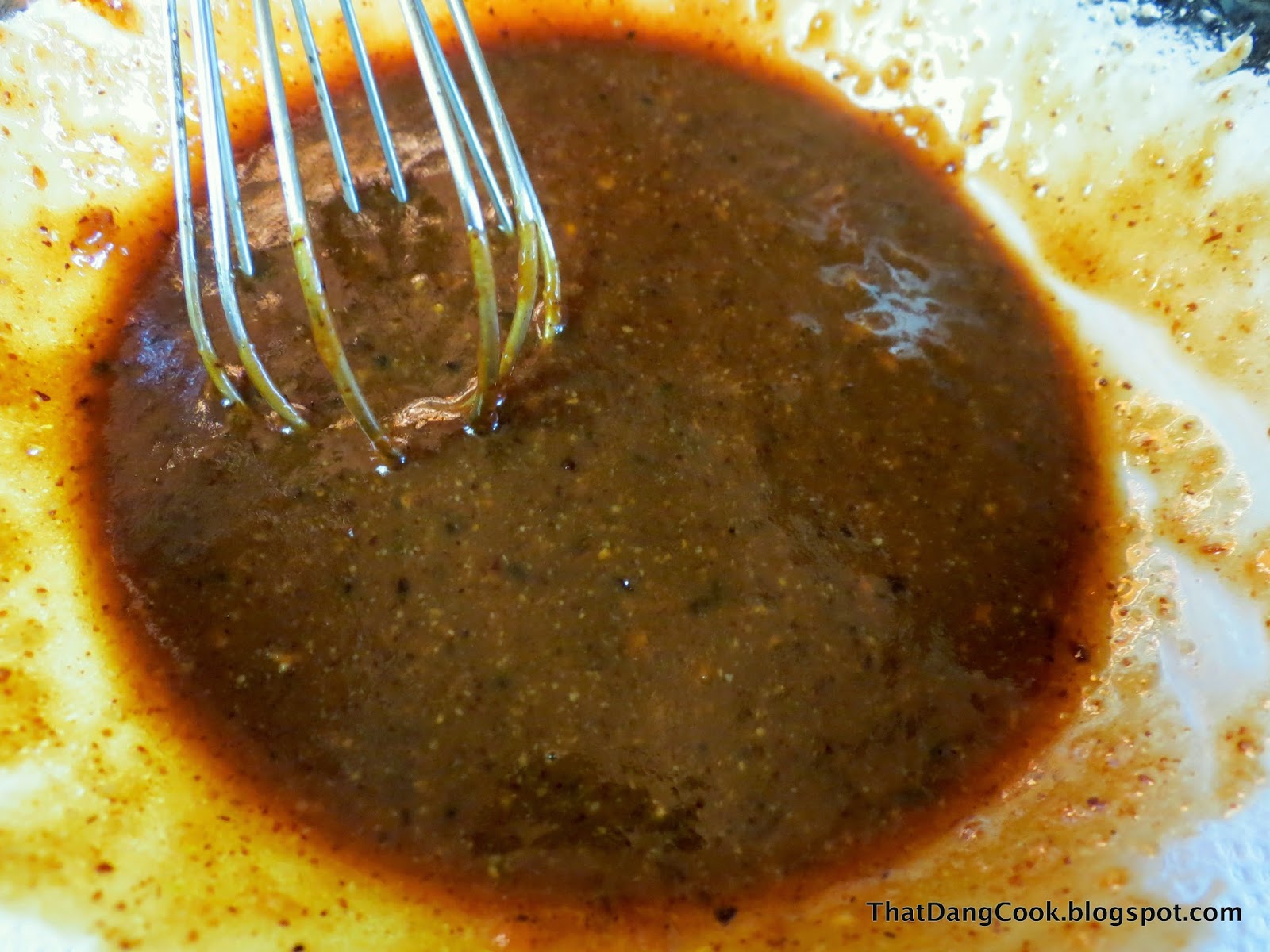

And when your pork is completely cooked through add the sauce to the skillet:


Turn the heat down to low at this point, cover it, and let it simmer for at least another 5 minutes to let the sauce soak in.


While the sauce is simmering, slice up some cabbage (optional) and thin cucumber slices.  

When the veggies are cut, drop 2-3 servings of noodles into the boiling water you prepared before you got started with the stir-frying.  Does it matter what kind of noodles you use?  Yes and no.  I've seen udon, soba, Chinese noodles, and even ramen (minus the spice packet) used for this dish.  I say go with whatever you like best.  I used udon.  Follow whatever directions come on your noodle package in terms of boiling time, then drain the noodles and rinse them briefly with cold water to prevent them from over-cooking.


Now we get to the arranging part.  Noodles go in the bowl first:


Followed by the cabbage and cukes:


And then the sauce.  


Now, if you're going for complete jajamen authenticity then you may want to puree the sauce so that it more closely resembles a thick paste than a stir-fry.  That is totally up to you.  I have this weird pet peeve where I hate washing my blender so I didn't puree the sauce, though it did change the texture and feel of the dish somewhat to skip that step.  If you do puree the sauce then just be sure to let it cool a bit before sticking it in your blender to avoid damaging anything.  A tiny bit of broth or sesame oil can help if it's too sticky to blend properly.

When eating jajamen in restaurants it's very common to get a wide array of condiments to mix with it, such as extra garlic, La-Yu (chili oil), chili paste, scallions, and even vinegar.  I myself love a deep spicy kick to my noodles, so I opted for a dash of sriracha:


Tadaa!  Dig in!

"But wait," you say with concern and dismay.  "What about the egg and the chicken broth from back at the very beginning?"  

I'm so glad you asked.  Eating the noodles is the first course of the meal.  You can choose to completely empty your bowl, leaving only the leftover sauce  or -- my preference -- leave about 1/4 of the noodles in the bowl:


At which point you crack the egg into the bowl (really!):


And immediately top it with the boiling chicken or vegetable stock you've had sitting on the stove.  Use your spoon or chopsticks to whisk everything around for a minute or two, thereby tempering the egg and making an impromptu egg-drop soup.  


Note: if the idea of cooking the egg in this way weirds you out too much, or if you want to leave no doubt that your egg is totally cooked through, crack the egg(s) into the boiling stock on the stove, whisk, and let them cook for 2-3 minutes that way.  The only real difference is that you'll end up with chunkier egg pieces rather than a rich, eggy broth.  That said, whether you add the egg to the soup or the soup to the egg it'll still cook through and will be delicious.  I promise.  But I do totally understand the queasiness some folks might feel about putting a raw egg into their bowl, so no judgment here if you choose to do it the other way.


So now you get to have soup as a second course!  Yum!  

This is a really great dish to warm you up on chilly day, especially around this time of year when winter hasn't quite given up its hold yet.


Jajamen (Morioka Miso-Garlic Udon)

Ingredients:
  • water for boiling noodles
  • 2 cups chicken or vegetable stock (from scratch, can, or bullion)
  • 2-3 servings of udon, soba, or Chinese noodles
  • one egg per person
  • 1 tsp vegetable oil + 1/4 tsp sesame oil
  • generous handful of mushrooms
    • note: for a more Chinese/Korean feel to the dish, other vegetables (e.g. zucchini) can be used in addition to or in place of the mushrooms
  • 2 pork chops, finely minced
    • can sub ground pork, diced eggplant, cubed extra-firm tofu, black beans
  • 2 tablespoons of miso paste (either red or white)
  • 1 teaspoon each of ginger paste and garlic paste
  • 1 teaspoon sugar
  • 1 tablespoon of rice wine (cooking sake)
  • 1 tablespoon of soy sauce
  • 1 tablespoon of mirin 
    • can sub an extra tablespoon of rice wine and an extra two teaspoons of sugar
  • 1 tablespoon of black bean sauce or sweet bean paste
    • see long-version of the recipe, above, for notes
  • small handful each of shredded cabbage (optional) and thinly-sliced cucumber
  • condiments according to preference, common options include:
    • scallions
    • La-Yu sesame chili oil
    • rice vinegar
    • garlic
Directions:
  1. In separate pans, put the water for the noodles and the stock on high heat.  Let these come to a boil while completing steps 2 - 8.
  2. Add the oils to a skillet on medium-high heat.  When the oil is hot, add the mushrooms and cook for 3-5 minutes or until softened.
  3. While the mushrooms cook, dice the pork.
  4. Add the pork to the skillet, stirring occasionally, and cook through (5-15 minutes, depending on size of the pork pieces).
  5. While the pork cooks, whisk together the miso, ginger, garlic, sugar, sake, soy sauce, mirin, and black bean sauce and set aside.
  6. When the pork is cooked through, add the sauce and reduce the heat to low.  Cover and allow to cook for a minimum of 5 additional minutes.
  7. (OPTIONAL:  Allow the stir-fry to cool until lukewarm and puree in a blender or food processor to make a thick paste.  If desired, return the paste to the stove and re-heat.  This step is not shown above although it makes a more authentic-looking end product.)
  8. While the sauce is simmering, slice the cabbage and cucumbers into small pieces.
  9. While the sauce is simmering, add the noodles to the boiling water prepared in step 1 above and cook for the amount of time indicated on the package.
  10. When noodles are done, drain & rinse briefly with cold water.
  11. To serve the noodle course:  layer the noodles, cabbage & cucumbers, and sauce in an individual-sized bowl.  Top with any condiments as desired.
  12. To serve the soup course:  Leave approximately 1/4 of the noodle course in the bowl.  To this add one egg and top with the boiling stock that you prepared in step 1.  Whisk using chopsticks or spoon for 1-2 minutes or until egg is cooked in the broth.  
  13. (Alternatively, drop the egg(s) into the broth while it is boiling on the stove and allow 2-3 minutes to cook through before adding to the bowl.)


Sunday, March 9, 2014

Miso Soup by Candlelight: Why I'm Furusato Sick (帰心)


I was going to make this week's post the continuation of the brunch series, but to tell the truth there's something else on my mind and this is as good a place as any for catharsis.  I want to take a second to talk about my heart's home back in Iwate.  This is not as much of a departure from recipes as you might think, for whenever I think of food I think of Japan and the little kitchen where I started to expand my culinary horizons:


Inevitably I also think of a gorgeous passage from Tanizaki's In Praise of Shadows where he discusses the uniquely somber aesthetic of Japanese food and serving ware:

"Whenever I sit with a bowl of soup before me, listening to the murmur that penetrates like the far-off shrill of an insect, lost in contemplation of flavors to come, I feel as if I were being drawn into a trance.  The experience must be something like that of the tea master who, at the sound of the kettle, is taken from himself as if upon the of the wind in the legendary pines of Onoe.

"It has been said of Japanese food that it is a cuisine to be looked at rather than eaten.  I would go further and say that it is to be meditated upon, a kind of silent music evoked by the combination of lacquerware and the light of a candle flickering in the dark.  Natsume Souseki, in Pillow of Grass, praises the color of the confection youkan; is it not indeed a color to call forth meditation?  The cloudy translucence, like that of jade; the faint, dreamlike glow that suffuses it, as if it had drunk into its very depths the light of the sun; the complexity and profundity of the color -- nothing of the sort is to be found in Western candies.  How simple and insignificant cream-filled chocolates seem by comparison.  And when the youkan is served in a lacquer dish within whose dark recesses its color is scarcely distinguishable, then it is most certainly an object for meditation.  You take its cool, smooth substance into your mouth, and it is as if the very darkness of the room were melting on your tongue; even undistinguished youkan can then take on a mysteriously intriguing flavor.  

"In the cuisine of any country efforts no doubt are made to have the food harmonize with the tableware and walls; but with Japanese food, a brightly lighted room and shining tableware cut the appetite in half.  The dark miso soup we eat every morning is one dish from the dimly lit houses of the past.  I was once invited to a tea ceremony where miso was served; and when I saw the muddy, claylike color, quiet in a black lacquer bowl beneath the faint light of a candle, this soup I usually take for granted without a second thought seemed somehow to acquire a real depth, and to become infinitely more appetizing as well.   ...   Above all there is rice.  A glistening black lacquer rice cask set off in a dark corner is both beautiful to behold and a powerful stimulus to the appetite.  Then the lid is briskly lifted, and this pure white freshly boiled food, heaped in its black container, each and every grain gleaming like a pearl, sends forth billows of white steam -- here is a sight no Japanese person can fail to be moved by."

Over the years I came to agree that darkness is part of what makes Japanese food and culture so beauitful.  As I mentioned in an earlier post, my favorite Japanese meal of the entire three years I spent there was enjoyed by lantern-light.  Even my teeny dining room looked best just as the sun began to set over the mountain:


Why all the nostalgia, you ask?  March 11th is the three-year anniversary of the Tohoku Earthquake and Tsunami.  Although I was back in the States by then, I remember that day as perhaps the single most heart-breaking moment of my life.  I remember sitting by the TV for days, barely able to see through tears, as I watched places I'd known and loved swept away.  I remember hysterically emailing old friends and colleagues from the coast, desperate to hear they were alive.  In the days immediately following and in the years since there has been a lot of focus on the Fukushima nuclear meltdown.  To me that is as tragic as the rest of it, though it is less real because Fukushima wasn't my home.  I feel for the people there, but my heart bleeds for the Iwate coast.  So I hope you'll indulge me in sharing with you just some of the stunning views I experienced when I lived near there.  

For example, from my little village smack in the middle of Iwate:


Of Mt. Iwate and Morioka, just to the north:


Of the coast, where I spent some lovely summer days at a stunning pinegrove beach that no longer exists:


And of the people who made my stay what it was, who did their best to struggle uphill against a lifetime of ingrained prejudicial attitudes and small-town bigotry to make an earnest effort at showing me acceptance and love.  Maybe it's the darkness that's overshadowed my memories of Iwate that make them so perfect in retrospect, like miso soup by candlelight.  


So if you get a moment over the next few days, please spare a thought or a prayer for the people of Tohoku and all they have lost.


Monday, December 9, 2013

Saba no Miso ni (Miso Poached Mackerel)


How often would you say you eat hamburgers?

If you're anything like me, the answer is "once a year, max."  There are people out there, no doubt, who eat them weekly.  Maybe even daily.  Most folks probably fall somewhere between the two.  It sort of straddles the line between a special occasion food and the quintessential fast food.

Just so with sushi.  When I lived in Japan I'd have it a few times a year, usually at work parties or when I'd hit up the local literally fast food joint in town.  Here in America, though, you'd think sushi was a nightly phenomenon considering how it's on just about every single Japanese restaurant menu (and features at a growing number of Chinese and Korean restaurants as well).

As you might guess, most of the recipes I miss most from Japan never appear in restaurants over here, even the exceedingly rare ones that are actually owned by Japanese people (so far I've found only one and it's in Porter Square in Cambridge).  Among my favorite recipes that don't make the cut are Japancakes (I'll be sure to introduce you to these soon) and mackerel.

Saba no miso ni (サバの味噌に) is mackerel that's been poached in a kind of miso-based sauce.  Unlike south Asian recipes, which are largely spice-based, Japanese recipes are more sauce/liquid based (think soy sauce and cooking wine).  Poached mackerel is one of those homey, everyday dishes that really take me back.  It's also phenomenally easy to make, so I thought it'd be a nice place to start for Japanese recipes, especially since Japanese cooking has just become the second cuisine to get cultural heritage status.

As usual, scroll to the bottom for a concise recipe.


Mackerel Poached in Miso Sauce

Total real time:  If I count cleaning the fish, it took about an hour.  If yours is already cleaned, then you're looking at about half an hour, 15 minutes of which is simmer time.

Weirdest ingredient:  Mirin.

Mackerel can be a rare find in grocery stores, depending on where you live.  When I see it on sale near me it's almost always an as-is fish that I have to clean myself.  A whole mackerel, if you will.

 Well, not any more.  Now it's full of holes.

I won't cover how to clean the fish yourself.  If you get one from a place that will clean it for you, then by all means do that.  Otherwise I think probably there are a hundreds of better places to learn it than from me.  The one thing I will emphasize, though, is to double-check for pin bones (the small ones that are -- get this -- pin-sized) because you don't really want to be chowing down on those later.  A pair of kitchen tweezers or sanitized needle-nosed pliers will make this job a lot easier.  Even really good markets will miss a few, so be sure not to skip this step.

Now, one of the very first things you will notice is that mackerel is the fishiest-smelling fish that ever fished.  Seriously.  It has a funk to it, even when fresh.  Doc came home three hours after I'd cleaned the fish and he still, er, observed that the kitchen had the tang of a fishmonger on a full moon.  The reason for the fishy funk is that mackerel, like salmon and sardines, is among the oilier kinds of seafood out there.  That oil is the good kind that keeps your coat shiny (when consumed in moderation, like every other thing).

The way to reduce that funk is to briefly swish the fish (teehee) in nearly-boiling water.  What I do is bring a pot of water to a boil and then add a generous splash of cold water to bring the temp down a bit.

It's about to get a really, really hot bath.

Let the fish soak in the hot water for about 10-30 seconds, just long enough for the fleshy bit to start turning white.  You'll notice I've left the skin on.  That's on purpose.  It's delish.

Ding!  Time to take it out and pat it dry.

Don't let it cook all the way.  Less than a minute is enough.

For comparison: the bottom one has been bathed, the top one has not.

I did four filets (each about half a pound) and by the end the water was gross.  Be sure to rinse the pot out well when you're done.

Ew.

Okay, so now you've got a bunch of (or perhaps just one) filet(s).  Wrap them up in paper towels while you get the sauce ready to roll.

Snug as a... fish.

The sauce is super easy.  What you want are equal parts mirin, sake/rice cooking wine, miso paste, and sugar.  Mirin is one of those things that you might think you'd never find, but surprisingly I find it in the Asian section of almost every grocery store I go into.  It's usually right there with the rice vinegar and cooking sake.  If you have to improvise you could double the sake and add a bit more sugar, but mirin's a really lovely thing to have on hand when cooking fish if you make it often.  It's got a smoothness and viscosity to it that regular sake lacks.

When making miso soup there is a kind of method of dissolving the miso paste carefully into the soup liquid using a ladle and your chopsticks.  We're not making soup here, though, so dumping all these things into the pan is a-ok in my book.  Just whisk them all together and give it a taste.  If it needs salt, add a splash of soy sauce (a little will do, miso's pretty salty on its own).  If it's too sweet, add a splash of rice vinegar.

For four filets I used 3 tablespoons each of mirin, sake, miso paste, and sugar.  You can go light on the sugar if you want, but keep in mind a big part of the purpose of the sugar is to counteract the saltiness of the miso/soy sauce, so just taste it as you go and add sugar gradually.

Left to right: ginger paste, mirin, rice vinegar, soy sauce, sake (aka rice cooking wine).

Bring it up to a light boil, then turn it down to a simmer.  At this point, if fishy tastes/smells really bother you you can add ginger (in slices or in a paste), garlic (likewise), and/or a few sprigs of green onion.  These are entirely optional ways to help de-fishy your dish.

When it's all whisked up and simmering it's time to add your mackerel filets.  

Ready, captain!

I didn't have whole green onions on hand, so that's what that green bottle to the left of middle is up there.  Handy as heck, let me tell you.

Before putting your fish in the sauce, score a little X into the skin.  This helps the sauce permeate the whole filet.  Plus it looks awesome.

X marks my dinner.

Go ahead and place the fish in the simmering sauce.  Now, most recipes I've seen talk about pressing the fish into the sauce with a lid for 15 minutes or using tinfoil to jury-rig one.  I don't like doing extra dishes, nor do I like wasting tinfoil, so I just flip the filet after about 7-8 minutes.

Notice the depth.  It doesn't need to be covered, hence flipping halfway.

When it's done the flesh will be flakey and the skin will have lost its sheen.

Ding!

How easy is that?  About 1/3 of the filet was more than plenty for my dinner.  


I served it over Japanese rice (the sticky kind used in sushi) topped with a splash of the miso poaching sauce from the skillet.  Playing alongside are soup and veggies.  Pretty standard everyday dinner.  Yummo!

How average!

Up next:  yellow lentils (basic dal).  


Quick Reference Recipe

  1. Carefully check a cleaned filet of mackerel for pin bones, removing any with kitchen tweezers or a sanitized pair of needle-nose pliers.
  2. Briefly swish the mackerel filet in water that is just below boiling in temperature.  Remove fish after the flesh just begins to turn white, less than one minute total.
  3. Dry the filet and wrap in a paper towel while preparing the miso sauce.
  4. In a small skillet on medium-high heat,  mix equal parts mirin, sake, and miso paste (typically around 1-3 tablespoons of each, depending on depth of skillet and number of filets).  Add sugar to taste; suggested amount is roughly equal to mirin/sake/miso.
  5. Taste the sauce, adding soy sauce if more salt is needed and rice vinegar if too sweet.
  6. Add a few slices of ginger, a clove of garlic, or a few sprigs of green onion if desired.
  7. When sauce is boiling, reduce to a simmer and add mackerel, skin side up.  Score skin with an X.
  8. Periodically spoon sauce over the skin.  After 8 minutes, flip the fish over carefully.
  9. Simmer for an additional 7-8 minutes or until thoroughly cooked.
  10. Repeat with any remaining filets.